By Cristina Carpio
I didn’t realize how attached I was to my phone until someone told me I couldn’t have it.
It was one of the first things I noticed when I arrived at AIRE Ancient Baths Toronto. Once you pass the change rooms, phones are not allowed. There would be no quick check of my messages between treatments, no taking photos of the candlelit pools, no responding to an email because I suddenly remembered something I had to do.
After what had been a particularly chaotic few months, the timing couldn’t have been better. I had been feeling like my mind was constantly running. There was always another message to answer, another notification to check, another task waiting for my attention. Even when I wasn’t working, I was still connected to everything happening around me. When I was invited to experience AIRE, I decided to take it as a sign to do something I hadn’t been very good at lately: stop.
Not catch up. Not multitask. Not squeeze one more thing into the day.
Just stop.
That may sound simple, but for many Canadians, disconnecting from our devices has become surprisingly difficult. Statistics Canada found that 64 percent of Canadians were checking their smartphones at least once an hour in 2020, with the figure even higher among younger Canadians. And in 2022, 22 percent of Canadians said they had taken a break from the internet or reduced their internet use because they felt they were spending too much time online.
I recognized myself in those numbers.
The phone has become an extension of our lives — and, sometimes, our bodies. It comes with us when we wake up, when we go to bed and, for some of us, even when we go to the bathroom. We check it while waiting for coffee, while watching television, while eating dinner and sometimes while having a conversation with another person. A notification can pull us away from the moment we’re in before we’ve even consciously decided to look.
So what happens when there is nothing to check?
Stepping away from the city
AIRE Ancient Baths Toronto occupies a restored 1912 Edwardian building on Front Street West in the Fashion District. At 23,000 square feet, it is the Spanish wellness brand’s first Canadian location and its 10th worldwide.
From the moment I walked inside, it felt as though the volume of the city had been turned down.
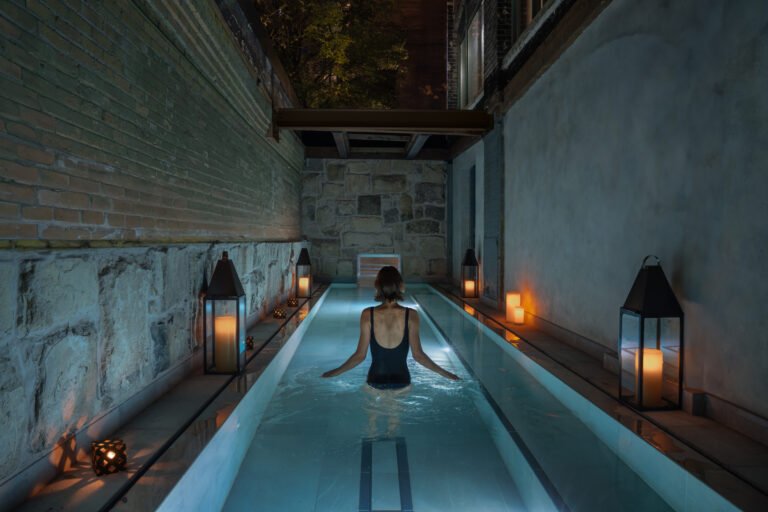
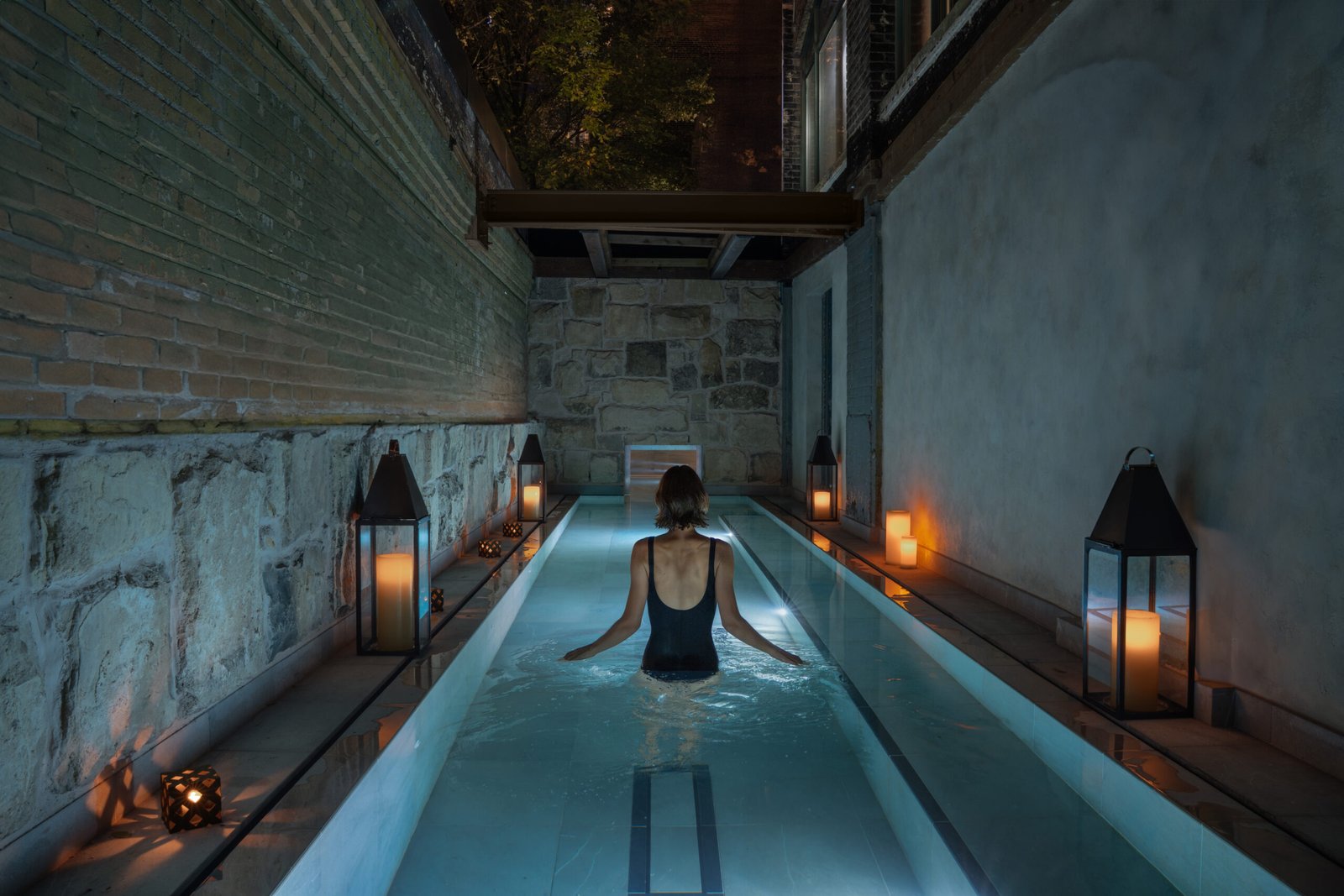
The original brickwork, exposed beams and industrial elements of the old building remain, but they have been softened by warm stone, candlelight and water. It is dark without feeling gloomy, quiet without feeling empty. The historic architecture gives the space a sense of permanence, while the baths create an atmosphere that feels completely removed from the Toronto outside.
It was strange to think that I was still downtown.
The experience revolves around a nine-bath thermal circuit, with water temperatures ranging from warm to cold. There is the Tepidarium, Caldarium and Frigidarium, along with the Balneum, also known as the Thousand Jets Bath, and a saltwater Flotarium where you can float almost effortlessly.
There is also a dry sauna, a vaporium, massage rooms and two warm marble beds. Outside, the Palestra Outdoor Bath brings the experience into the open air, surrounded by the energy of the city but somehow insulated from it.
What I appreciated most was that I wasn’t being rushed through any of it.
After my massage, I went back to the baths. There was no feeling that I had to hurry because my appointment was over or that I needed to move on to the next thing. I could stay in the water, sit in the sauna or simply do nothing.
And doing nothing turned out to be harder than I expected.
When doing nothing becomes the whole point
We have become so accustomed to filling every quiet moment that silence can feel uncomfortable.
If we’re waiting, we reach for our phones. If we’re eating alone, we scroll. If we’re sitting in traffic, we listen to something. Even relaxing often comes with a screen.
Canadian data reflects just how much recreational screen time has become part of everyday life. In 2021, 62 percent of Canadian adults met the recommended guideline of no more than three hours of recreational screen time a day — meaning more than one-third did not.
The issue isn’t necessarily that technology is bad. It has made our lives easier in countless ways, and being connected can be incredibly useful. The problem, perhaps, is that we don’t always know when to stop.
For me, that became obvious when I realized I hadn’t thought about my phone for quite some time.
I wasn’t wondering who had texted me. I wasn’t thinking about emails. I wasn’t checking the time. I wasn’t thinking about taking a picture of the experience so I could post it later.
I was just there.
And then came the cold plunge.
The cold plunge
I wasn’t particularly excited about getting into freezing water. But something about the challenge of it appealed to me, and once I did it, I understood why it had become one of my favourite parts of the experience.
I went from the cold plunge to the sauna and repeated the cycle a few times. The sensation was exhilarating. The cold water immediately demanded my attention — there was no room to think about work or whatever else might have been occupying my mind. I had to be completely present.
Then I returned to the warm water, and everything slowed down again.
That contrast between cold and heat made me more aware of my body, but it also made me aware of how rarely I actually stop long enough to notice how I’m feeling.
We often talk about wellness as something we need to add to our lives. More exercise. Better sleep. Meditation. Supplements. More steps. Another appointment.
But maybe sometimes the answer is simply to remove something.
The luxury of being unreachable
That is what makes AIRE’s concept interesting. The luxury isn’t necessarily the massage or the beautiful surroundings, although both are certainly part of the experience. It is the opportunity to become temporarily unreachable.
AIRE CEO Amadeo Serra says the company’s approach is rooted in bringing ancient bathing rituals into restored historic buildings.
“These places have a soul, they tell stories,” he says. “When you’re floating in a candlelit bath in a space with a century of history, time slows, the mind quiets, and you feel part of something much bigger.”
Sitting in the Toronto location, I understood what he meant.
There is something about being inside a building that has been here for more than a century, surrounded by water and candlelight, that makes the pace of everything else seem less important. For a few hours, there was no reason to know what was happening on my phone.
No one needed an answer from me.
And perhaps that is one of the hardest things for us to permit ourselves to do.
Canadian research has found that people who spend less time online are more likely to report very good or excellent mental health, although the relationship between internet use and well-being is complicated and influenced by many factors. Still, the numbers are a reminder that how we use technology — and how much space it occupies in our lives — is worth paying attention to.
For me, the experience wasn’t about giving up my phone or suddenly deciding I wanted to live a completely screen-free life.
It was much simpler than that.
I wanted to remember what it felt like to be somewhere without needing to document it, respond to something or check what I had missed.
Maybe the reset starts with less
I am not naturally good at being still. I like being productive. I like having something playing in the background. I like knowing what is happening. I like being reachable.
But sitting in those baths, I started to wonder whether being constantly reachable has come at the expense of simply being present.
Maybe we don’t need a dramatic digital detox or a week away from civilization. Maybe we just need to practice stepping away more often.
Leave the phone in another room for an hour. Go for a walk without it. Eat dinner without checking messages. Sit somewhere beautiful without immediately reaching for the camera. Take an afternoon to do absolutely nothing.
AIRE reminded me that unplugging doesn’t have to be complicated. Sometimes it is simply deciding that, for a little while, you don’t need to respond to the world.
And when I finally picked up my phone again, I didn’t feel like I had missed anything.
If anything, I felt like I had gotten something back.
A little quiet.
A little space.
And the feeling that my mind had finally had a chance to catch its breath.
Maybe that is what a reset really looks like.
Not adding another thing to our wellness routine, but taking something away.
Less noise. Less scrolling. Less reacting.
And, every once in a while, the luxury of being unreachable.